News / technical selection
Single or two-stage pulping: define the separation task first
A second chamber is not automatically a better answer. Decide whether the job is extraction, finishing or two distinct duties, then define the evidence that must pass between them.
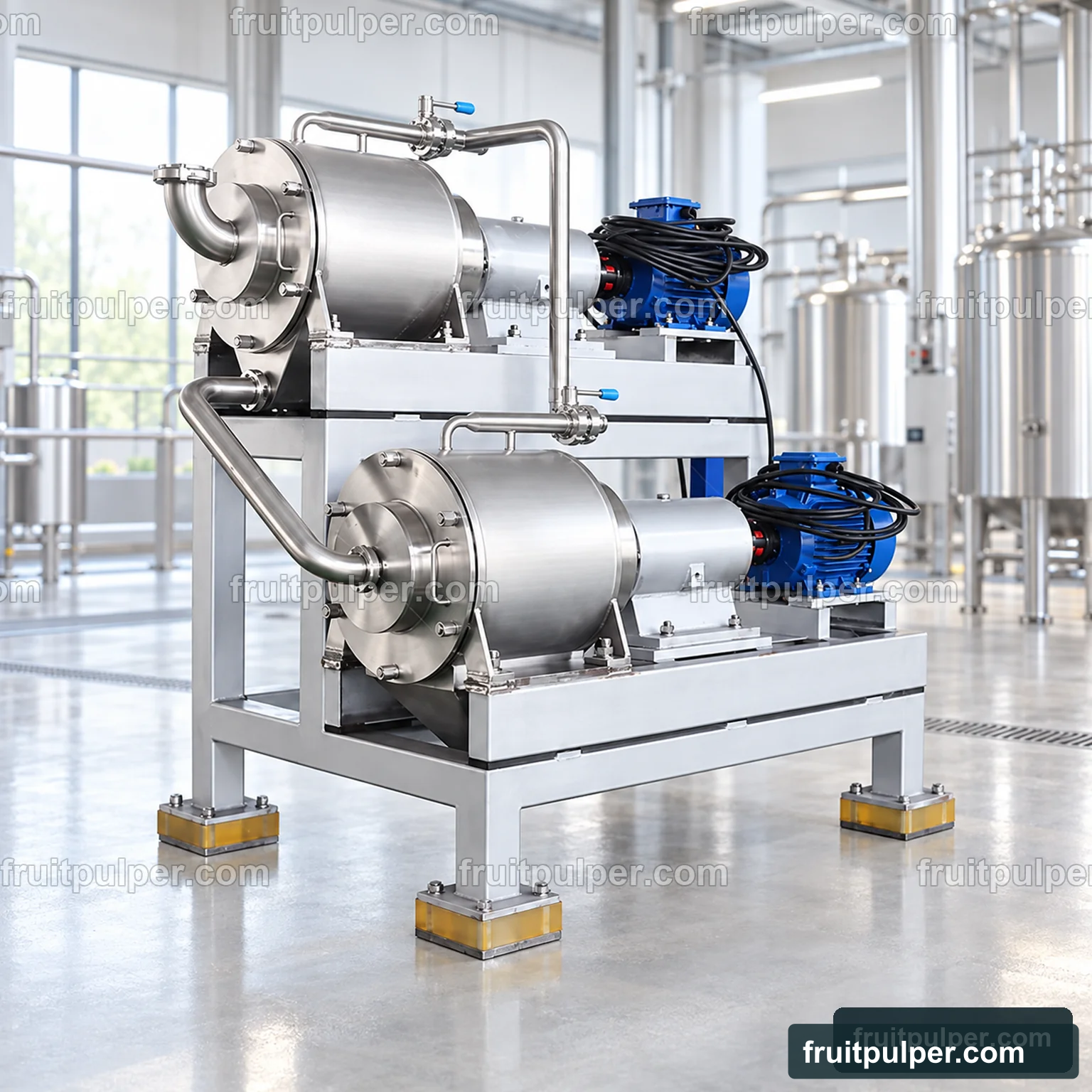
Two stages describe an arrangement, not a double yield
A two-stage pulper is one machine with two separation chambers, not two independent machines supplied as a set. Each chamber can have its own screen, drive, product path and reject path, and the accepted stream from the first stage becomes the feed to the second. That arrangement can be useful when coarse removal and final texture need different conditions. It does not double the fruit output, guarantee a finer product or make an unsuitable feed acceptable.
The first question is therefore not “one stage or two?” but “what must happen to this material?” If a single screened separation produces a product that meets the agreed texture, defect and reject requirements, a second chamber may add cost, cleaning work and another transfer point without improving the result. If the product brief requires a coarse first separation followed by a distinct finishing duty, a two-stage arrangement may be the more honest description of the work.
Separate extraction from finishing
Primary pulping receives prepared fruit and opens the flesh so that a screened fraction can be collected. Finishing receives a stream that has already been separated, and refines its texture or removes additional solids. Those are different feed boundaries. Whole or crushed fruit presented to a finishing chamber is not the same duty as a prepared pulp presented to a primary pulper.
The FAO guide describes pulpers and finishers as equipment that separates juice from particulate matter, and notes that two pulpers in series with progressively finer screens can clean up some juices. The same source emphasizes fruit-specific preparation and warns that over-comminution or excessive extraction can carry undesirable skin and seed components into the product.
Write one sentence for each intended stage: what enters, what must leave, and what is rejected. If those sentences are nearly identical, a second stage has not yet been justified. If they describe clearly different duties, the next question is the interface between them.
Record the target texture and the seed policy
Texture is a product decision, not a screen number. Coarse pulp, refined puree and a juice with a defined pulp level imply different particle sizes, fibre lengths and tolerances for seed or skin fragments. The product brief should describe the intended use, the accepted texture range and the method used to assess it. A screen aperture alone does not define the finished product.
Seed policy needs the same clarity. Some products retain seeds or seed fragments by design; others require their removal. For large-stone fruit, the stone must be handled before a fine screen is asked to do a job it was not arranged for. The FAO tropical-fruit chapter illustrates fruit-specific arrangements, including a mango pulper with a discharge throat sized to eject the intact seed and a passion fruit finisher that separates seeds from juice. These examples show why the feed and the target product must be stated together; they do not establish a universal configuration.
If the requirement is “no visible seed fragments”, define what visible means, how the sample is prepared and who decides. If the requirement is “intact stones”, define the stone-size range and what counts as damage.
Assess the interface between the stages
The interstage transfer is a process boundary in its own right. The first-stage accepted stream may be pumped, gravity-fed or conveyed to the second chamber. Its temperature, air exposure, consistency and flow stability can change on the way. A small buffer may cause surging; a long transfer line may add residence time or cleaning difficulty.
Sample the first-stage product before it enters the second stage, then sample the second-stage product and reject. That gives three evidence points rather than one. If the final product is acceptable but the first-stage reject contains useful pulp, the arrangement may be losing value before the second stage begins. If the second-stage reject is unexpectedly large, the first stage may be passing material that the second screen cannot handle.
Agree who supplies the transfer equipment, controls and interlocks, and how a blockage is detected. The pulper quotation may not include the buffer or pump, and the interface should not be left to an installation-day assumption. Elevations, drain points and access for inspection belong in the layout discussion.
Plan cleaning around both chambers
Two chambers mean two screens, two sets of seals and a transfer path that also needs cleaning and inspection. That does not make a two-stage machine unhygienic, but it does change the cleaning brief. Confirm access for screen removal, chamber inspection, drain points and reassembly rather than assuming a cleaning connection reaches every product-contact surface.
Changeover time should be measured on the actual arrangement rather than inferred from a chamber count. Product change, allergen control, colour carryover and microbial hygiene may each impose different cleaning requirements. The acceptance plan should state the method, the inspection points and the evidence that cleaning has been completed before the next product run.
If a single-stage machine meets the product brief, its simpler cleaning boundary may be a real advantage. If a second stage is needed, the cleaning task should be priced and planned as part of the system, not treated as an afterthought.
Build a trial that can justify the second stage
A credible comparison uses the same fruit, preparation and feed basis for each arrangement, or explains why an exact comparison is not possible. Record first-stage feed, product and reject; second-stage feed, product and reject; and the final combined result. Weigh the streams over the same interval and report mass closure. Inspect texture, seed or stone integrity and useful pulp in each reject.
Set the acceptance criteria before the run. “Finer” is not a criterion unless the product brief defines the target and the measurement method. “Less reject” is not automatically better if the reject still contains useful pulp or if the product carries more fibre. The second stage should earn its place by improving the agreed product or by making a necessary separation more controllable.
Include the cleaning and operator tasks in the comparison. A stage arrangement that looks preferable on a product sample may be less practical if it adds inaccessible surfaces, difficult screen changes or unstable transfer.
What to put in the enquiry
Send the fruit or blend, preparation, prepared-feed rate, target texture, seed or stone policy and the intended downstream process. State what you expect each stage to do if you are asking for two stages. Ask for the proposed screen arrangement, transfer interface, utilities, cleaning access and the selected drawing, together with the samples that will be reported.
A supplier should be able to explain why the proposed number of stages fits the stated duty. If the answer is only that more stages are better, ask for the evidence. If the answer is that one stage is enough, ask how the reject and product will meet the brief. The basis makes either answer reviewable.
Questions that clarify the stage decision
- What enters each stage, and what must leave it as product and reject?
- Which product attribute requires a second separation: texture, fibre, seed fragments or something else?
- How will the interstage stream be transferred, buffered, sampled and cleaned?
- What seed, stone or fibre evidence will be collected from each stage?
- Which acceptance criteria are agreed before the trial, and how will they be measured?
Sources and scope
These references support the processing principles and method discussed above. They do not establish a material-specific result for any machine, and the article does not convert their examples into a fruitpulper.com performance claim.
- FAO — Principles and practices of small- and medium-scale fruit juice processing, Chapter 6: general juice manufacture principles
Pulping, screening, feed preparation and the caution against over-extraction.
- FAO — Principles and practices of small- and medium-scale fruit juice processing, Chapter 15: tropical fruits
Fruit-specific preparation and finishing examples for mango and passion fruit.
- UNIDO — publication record 9656458
Publisher record retained for further agro-processing reading; the full document was not available during this review and is not the basis for a quantitative claim.
Put the note to work
Describe the duty before the chamber count
Share the feed, target texture and seed or stone policy. We can frame the stage arrangement and the trial evidence around that brief.